
OVERVIEW
Approached by Greg Moseley again to help produce work for a new DJ alias he wants to grow ‘Bouvier’. The middle name of famous cartoon character Marge Simpson, this gave me a specific, yet wide range of ideas and options. The client’s original idea was to use to very well recognised blue hair of the character and had made a very brief image of what you envisioned. With free rein of the direction of this logo, with the only demand to ‘make sure it’s subtle’; to not be immediately corresponded with Marge.


IDEA & PROCESS
Following the first image that the client had made, the concept was to abstract the hair of the Simpsons character and implement the alias name within.


Happier with the second type and layout, but reflecting critically on my own work I don’t believe that the aesthetic represents my capabilities. Although the design fits the brief, overall it is not a strong piece of work. In response to this I will aim to find further ‘subtle’ symbols of Marge Simpson to create a better reference and a better outcome that is both easily identifiable yet still a strong enough image to stand by itself.
Following feedback from a tutorial with Richard, I aspired to elevate my 2D illustrative work to the next level, developing 3D design using Cinema4D. Unimpressed with my last outcome for this project, this seemed to be the perfect opportunity. The character’s iconic blue hair is matched with the green dress, but for me the largest symbol of Marge’s outfit is the bright orange pearl necklace. Fans of the show would agree, her look is not complete without them.
Initial Logo Concept Design Speedart
In order to document my method of working better I began recording my screen whilst working using QuickTime Movie, then speeding up the footage in After Effects and uploading it to a public domain, YouTube. To begin with this process was very difficult as my laptop storage was full and hard drive broken. However, transferring files and deleting unneeded documents frequently became a quick solution, albeit not suitable in the long term.

Despite fulfilling the replication of Marge’s pearls, reflecting on the outcome at a later date I recognised the reflectance of the pearls, contrasted by the lifeless colour of the text didn’t emphasise the right characteristics for the alias and in addition was quite hard to read. Refining my choices, I recreated the orange material; turning reflectance and luminance down whilst choosing a deeper orange to further resemble Marge’s pearls. The contrast of the dark text still didn’t suit the aesthetic so I opted for use of a chrome material to level out the loss of reflectance in the pearls, portraying the vivid lighting and shadows clearer.


Asking the client for their feedback, he replied that he is impressed with the concept of using the orange pearls of Marge Simpson but is worried that the composition may come across a bit bingo-like. In agreement, I decided to work on the concept further to try and depict what makes it looks ‘bingoey’ and get to an outcome that we were both happy with.
Discovering the shape and layout of the ‘pearls’ were the main issue with the bingo-like theme, I decided to use a different font and to restructure the layout of the pearls and text, creating various arrangements and send them to the client to see which he preferred.


Both undecided, but leaning towards the straight line we took to Instagram polls to see what the public preferred to help us make a choice. The three options the client and I were in discussion about were then uploaded to help us see if a larger audience could come to a definitive answer.
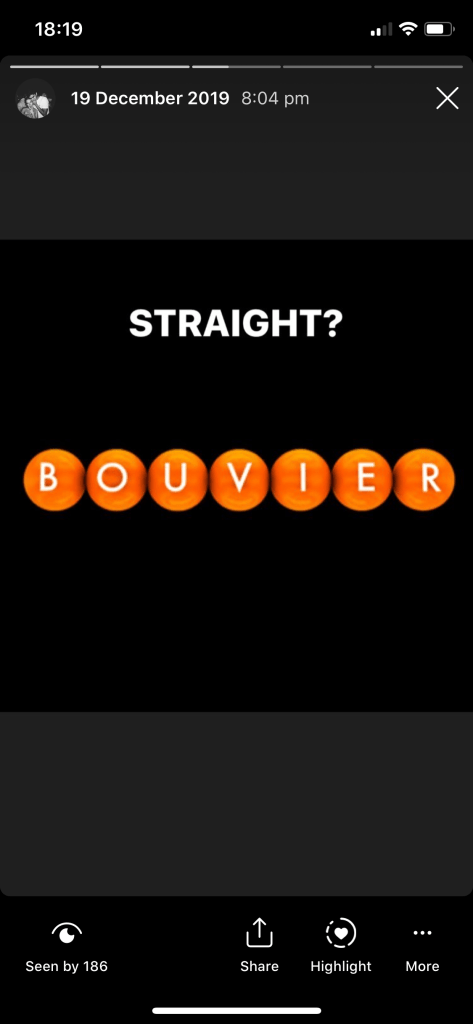
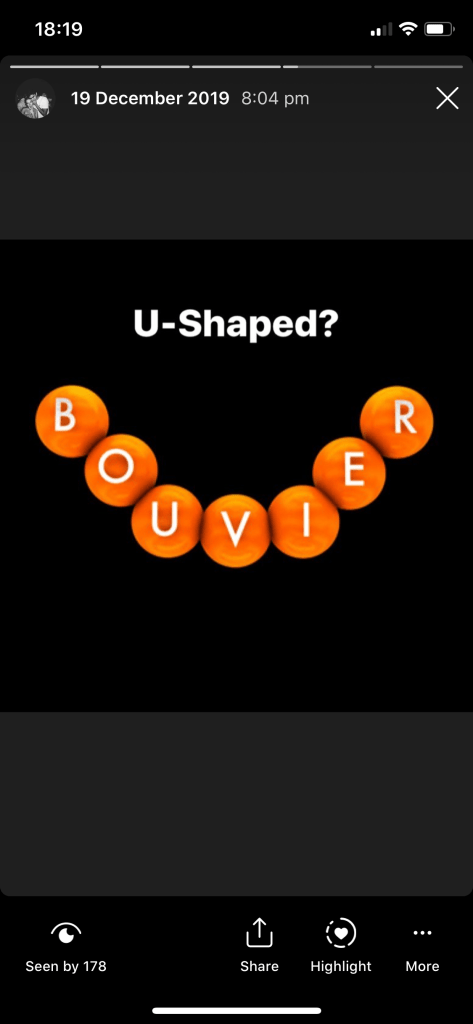


With the vast majority choosing ‘straight’ and the least opting for ‘u-shaped’, Greg was happy for me to continue creating an animation with this new information. I wanted to create something simple yet effective, portraying the full logo whilst promoting the client’s new alias and music. Starting with a tight angle to make the audience try and piece the puzzle together, finishing with a wide shot of entire logo, I decided to animate the pearls rotating around with the letters revealing themselves as time goes on.
Bouvier Logo Animation & Process
Time lapse/speed-art video demonstrating the process of creating the Bouvier animation for client Greg Moseley.
To enhance the final outcome, I edited the animation within Adobe After Effects, creating a dynamic animated geometric background, incorporating the blue of Marge’s hair and the orange of the pearls. Adding a light leak overlay, colour corrected to emphasise the colour split within the second half of the animation.
LNER EP Artwork
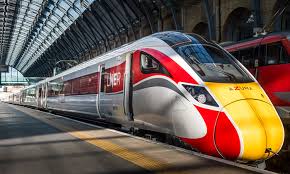

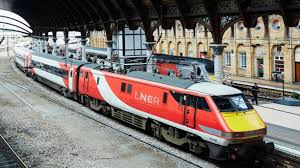


Although the client seemed relatively happy with the initial results, however the work didn’t meet the standard of what I had envisioned. Struggling to make many improvements within illustrator, I offered the option to make a 3D model and animation for Greg Moseley instead, of which he seemed more than happy to endorse.
EP Artwork | 3D Animation (incomplete)
Attempting to recreate a LNER train in Cinema4D is definitely one of the most ambitious tasks I have taken on, as it consists of a lot of different modelling and deconstructing skills within the program that I haven’t yet learned. Watching various YouTube videos such as the one above helped me better understand the possibilities and variations I could make.
Difficulties arose when attempting to disassociate the door from the rest of the train model and create it as a separate object. This was a struggle because the door was so detailed it had various minute segments that were very hard to see when inspecting it from the front. Selecting each segment required turning the camera a full 360 degrees to ensure each flat surface could be chosen which proved to be very time consuming as shown above. In addition to this, the recording of my process corrupted after a certain amount of time, meaning I am only able to display around the first half of my working process in the time lapse.
This brief alongside the Common Ground project helped me to better understand time management when using Cinema4D, as I ended up creating multiple versions of the same clip in order to get it right as I noticed flaws after rendering each one. This was difficult as it consumed a lot more time than needed and slowed down the entire process which, although wasn’t a massive issue for the client, could prove to be a bigger issue in the future with larger clients with specific deadlines. I’ve learnt to pre-render specific frames or segments whilst developing the animation to check for any possible faults, clipping issues or incorrect key-framing for example.
Above is my first attempt at creating an animation for the LNER EP for Bouvier (Greg Moseley). However, it immediately came to my attention how I didn’t account for the lighting within the train in the opening 3 seconds. This meant that although the outside of the train was lit perfectly, the text that I managed to render inside the opening doors was shut off to a light source. Required to remake the first 250 frames again, I taught myself through use of YouTube tutorials how to make a realistic flickering light within C4D by using an XPresso Tag; correlating a noise effector with the light’s intensity and key-framing the noise scale, amplitude and frequency until it creates the right effect.
Expanding through this project, it has become apparent to me how important storyboarding animations can be. This has proved to be an important aspect of animation that I am yet to thoroughly learn. Pre-planning methods create a template for you to follow and have a better understanding of steps needed to take; this stops sway from the original intentions of the design. In this case, I failed to pre-plan different angles and shots as I found it important to experiment and find what works, without a clear image in mind.
In attempt to strengthen this animation, my aim is to create the entire scenery to match the aesthetic of the train. In essence, my ambition is to create a more detailed, 3D render of my initial 2D illustration above. Although I have started this process, creating a whole scene from scratch is a very lengthy process, and setting myself realistic goals I will not be able to finish this within module 601 but will be something I continue with afterwards.

